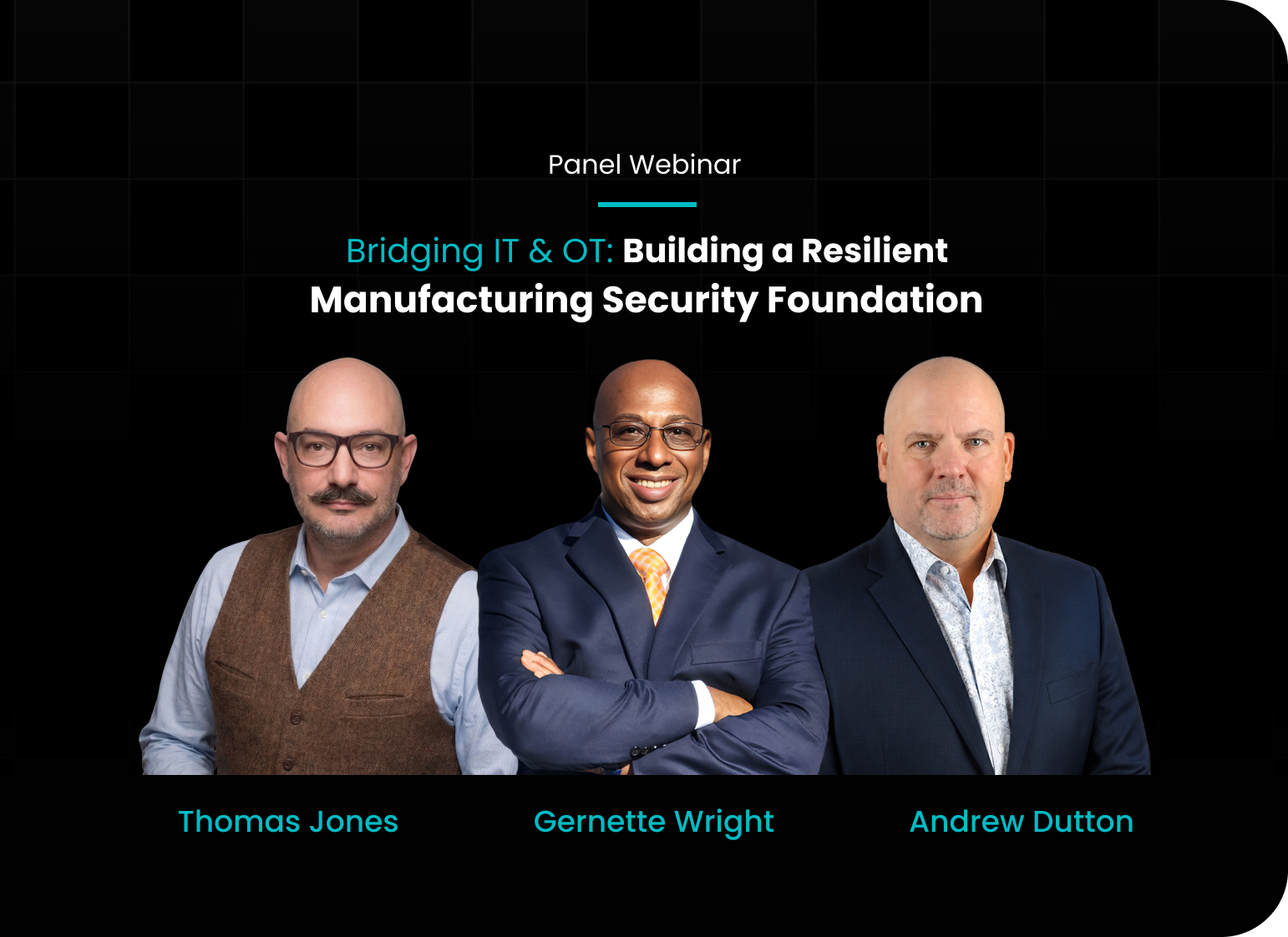

On May 21 at 11:00 a.m. MST, Fountain hills Technologies hosted an engaging webinar, “Bridging IT and OT: Building a Resilient Manufacturing Security Foundation,” bringing together cybersecurity leaders with decades of experience across manufacturing, industrial operations, data governance, and AI. The discussion ran well beyond its scheduled time, driven by active audience participation and the speakers' enthusiasm to continue the conversation.
The webinar featured:
Gernette Wright, Cybersecurity & Risk Leader CISSP, CISM, CIPM, CGEIT, CISO with over 20+ years of experience leading security transformations at organizations including Schneider Electric, Dentsply Sirona, and CIRCOR International. MIT Sloan Executive Certificate holder.
Andrew Dutton, Regional Cybersecurity Architect and Leader at Sumitomo Chemical, with 30+ years securing industrial environments across the Americas. Expert in OT/ICS security, anomaly detection, SASE, and cloud security.
Thomas Jones, CDAIO/CISO, Head of security, risk and compliance. Senior Industry Expert with 20+ years in leading cybersecurity, data governance, and AI strategy across global manufacturing. Bridges data protection and business value creation.
Moderated by Fountain Hills Technologies, the discussion focused on the realities of securing modern manufacturing environments where Information Technology (IT) and Operational Technology (OT) are becoming increasingly interconnected.
Visibility: The Starting Point for Security
One theme surfaced repeatedly throughout the webinar: visibility remains the foundation of effective cybersecurity.
When asked about the single biggest cybersecurity mistake manufacturers make on the plant floor, the panel pointed to a common issue—organizations often underestimate their risk exposure because they lack visibility into their environments. Many manufacturers have invested in network segmentation and security technologies, yet they still struggle to identify what assets are connected, who has access, and how information flows between systems.
As Andrew Dutton emphasized,
Visibility is the key to security. If you dont know it, you cant secure it.
The panel agreed that without a clear understanding of the OT environment, even the most advanced security controls become difficult to implement effectively.
IT/OT Convergence Is No Longer Optional
Manufacturing organizations are becoming more connected than ever before. Industrial control systems, production equipment, cloud platforms, and enterprise applications are increasingly intertwined, creating both opportunities and risks.
Drawing from his experience leading security programs across multiple global organizations, Gernette Wright highlighted a challenge many manufacturers face today:
Weve done a good job segmenting IT and OT environments, but we havent done a good job with monitoring and visibility.
While segmentation remains important, the panel noted that many organizations still lack the continuous monitoring needed to detect threats and understand their exposure across connected environments. As operational technology becomes more integrated with traditional IT systems, maintaining visibility and control becomes essential.
Cybersecurity, Data, and AI Must Work Together
Another key discussion focused on the growing intersection of cybersecurity, data governance, and artificial intelligence.
Manufacturers are rapidly exploring AI-powered solutions to improve efficiency, optimize production, and gain deeper operational insights. However, the panel cautioned that AI initiatives must be supported by secure and well-governed data.
Thomas Jones challenged the traditional view that cybersecurity, data, and AI are separate functions. Instead, he encouraged organizations to think strategically about their objectives.
You have to understand what youre protecting and why it matters to the business.
The speakers discussed how poor data quality, insufficient governance, and weak access controls can create significant risks as organizations expand their use of AI technologies. The message was clear: protecting data and extracting value from it are increasingly part of the same discipline.
Building Trust Between IT and OT Teams
One of the most practical discussions of the webinar centered on the relationship between IT and OT teams.
Although both groups share responsibility for protecting the organization, they often operate with different priorities, objectives, and perspectives. The panel emphasized that successful cybersecurity programs require more than technology—they require collaboration.
Thomas Jones encouraged security leaders to spend time understanding operational realities and engaging directly with plant personnel.
I get to know something I didnt know before every time I walk the floor.
Gernette Wright reinforced the importance of shared goals and mutual understanding.
Shared goals win. Security isnt about one team winning every battle—its about protecting the business together.
Andrew Dutton added that effective communication requires learning how different stakeholders think and speak, whether they are engineers, operators, or cybersecurity professionals.
Resilience Must Be a Business Priority
When asked what organizations should do if they do not yet have a dedicated OT security program, the conversation quickly shifted to resilience.
The panel stressed that cybersecurity can no longer be viewed solely as a technical challenge. A cyber incident that disrupts production affects far more than systems—it impacts customers, employees, suppliers, and shareholders.
As Thomas Jones explained,
When operations go dark, its not just production that stops. Employees, customers, and investors all feel the impact.
Building resilience requires stakeholder alignment, risk awareness, business continuity planning, and a clear understanding of how critical operations will continue during and after a disruptive event.
The Threats Keeping Manufacturing Leaders Awake at Night
While ransomware continues to dominate headlines, the panel highlighted several emerging concerns that deserve equal attention.
Identity management within legacy OT environments remains a significant challenge.
Many industrial systems were not designed to support modern authentication methods, creating opportunities for attackers to exploit weak credentials and shared accounts.
Supply chain risks, unmanaged vendor access, and the lack of visibility into connected assets were also identified as major concerns. The speakers discussed how the speed of exploitation has accelerated dramatically in recent years, leaving organizations with less time to react to newly discovered vulnerabilities.
Their recommendation was straightforward: manufacturers must know their assets, understand their attack surface, and continuously assess risk before adversaries do.
Audience Questions Highlighted Real-World Challenges
The webinar concluded with a highly interactive Q&A session that extended beyond the scheduled end time due to overwhelming audience engagement.
Attendees shared experiences that reflected challenges faced across the manufacturing sector. One participant described a longstanding concern about vendor remote access that had never been reviewed or revoked. The panel unanimously agreed that unmanaged third-party access represents a serious risk and emphasized the importance of visibility, monitoring, contractual controls, and access governance.
Another attendee referred to an aging SCADA environment as a “sleeping dragon,” explaining that previous modernization attempts had caused operational disruptions, making teams hesitant to pursue necessary updates. The discussion underscored a reality many manufacturers face: balancing production reliability with modernization and security improvements.
The panel acknowledged that these concerns are common across industrial environments, reinforcing the importance of planning, stakeholder engagement, and a phased approach to modernization.
Looking Ahead
The webinar reinforced a powerful message: cybersecurity is no longer just an IT responsibility—it is a business imperative that requires visibility, collaboration, and resilience across the entire organization.
As manufacturing environments continue to evolve through digital transformation, AI adoption, and increased connectivity, organizations must bridge the gap between IT and OT to build a stronger security foundation.
At Fountain Hills Technologies, we are committed to helping manufacturers navigate these challenges and create secure, resilient operations that support both innovation and business growth.
Ready to Understand Your Security Exposure?
Many manufacturers know there are gaps—they just don't know where they are.
Our OT Security Jumpstart helps uncover hidden risks, identify critical vulnerabilities, and provide a clear roadmap for strengthening your security posture. In as little as 3 days, we deliver a customized 25+ page executive security report, your top vulnerabilities, and a practical 30/60/90-day action plan—with minimal impact on your team and zero downtime.
Missed the Webinar?
Email us to receive the recording and discover practical strategies to strengthen cybersecurity, improve operational resilience, and successfully bridge the IT/OT divide.
Contact Fountain Hills Technologies today to continue the conversation.